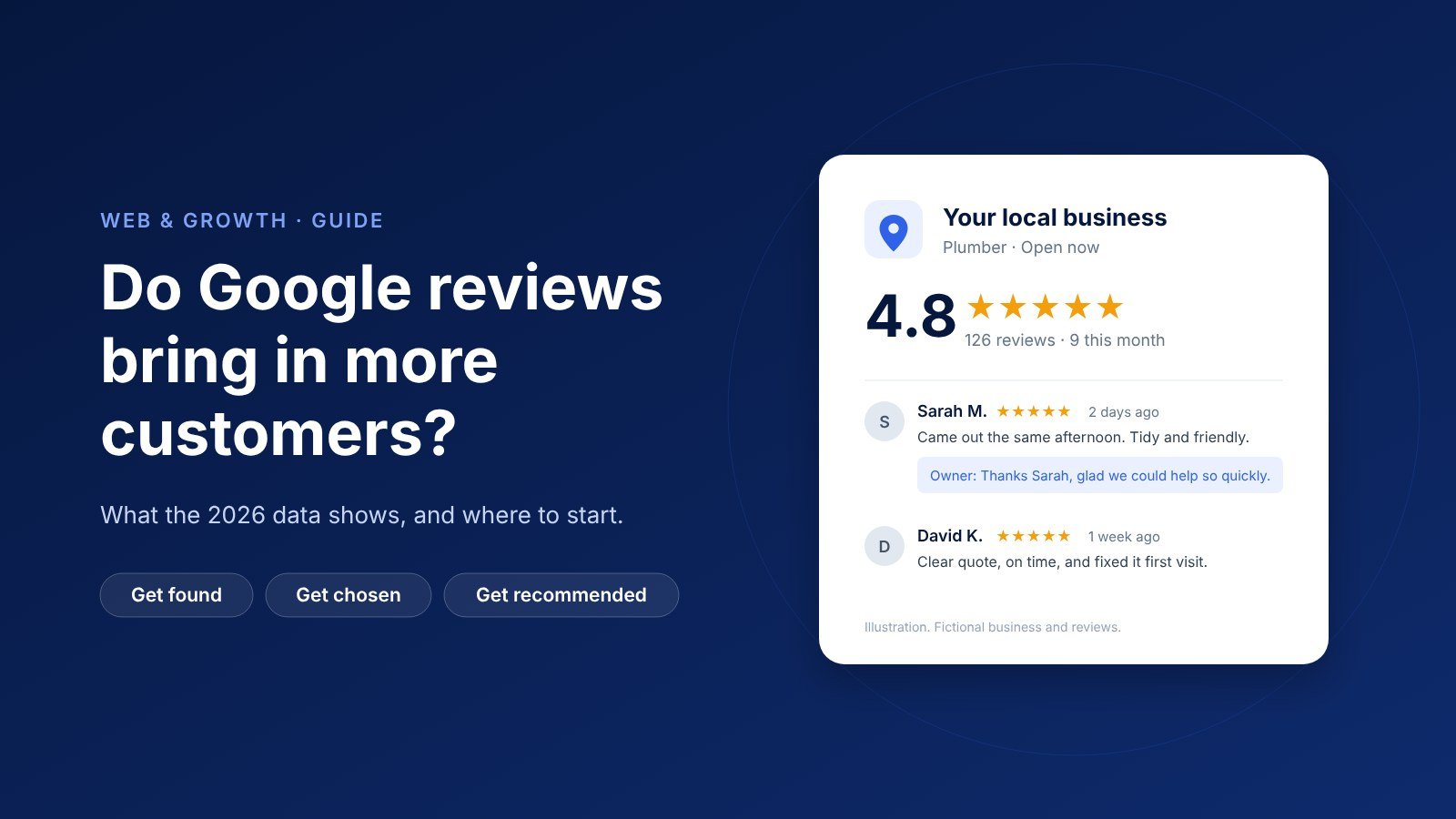
Yes. Google reviews help in three ways at once. They're one of the signals Google uses to decide which local businesses to show, they're often what a customer reads before deciding to call you, and AI tools like ChatGPT and Google's AI Mode now summarise them when someone asks for a recommendation.
What matters most is a steady flow of recent, genuine reviews, and replies that sound like a real person wrote them. Below is what the current research shows, what you're not allowed to do in Australia, and a simple place to start.
Do Google reviews help my business rank higher?
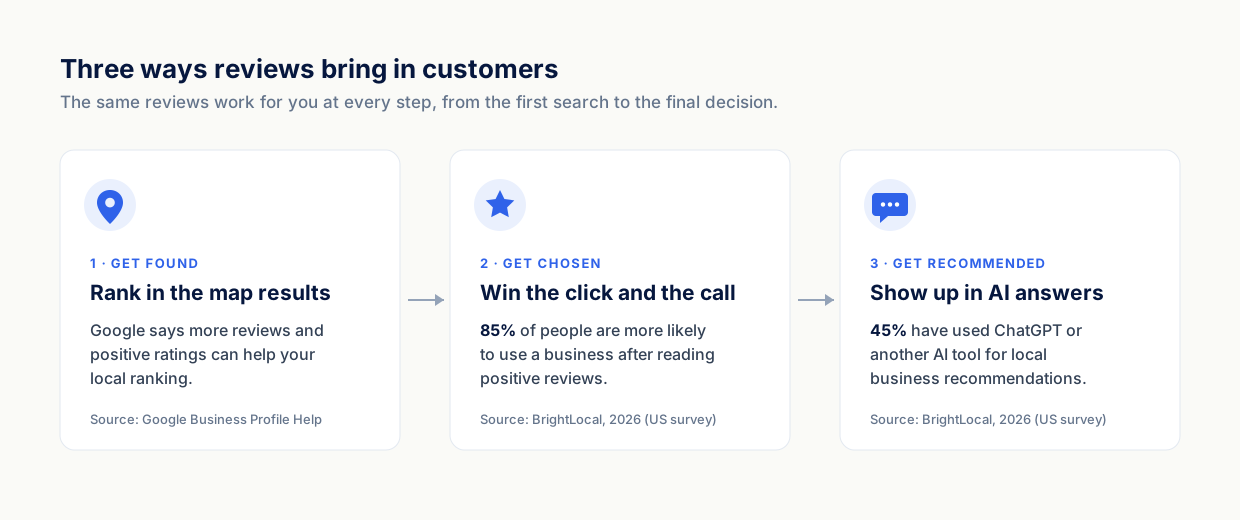
They do, though they're one factor among several. Google says local results are based on three things: relevance (how well your profile matches the search), distance (how far you are from the person searching) and prominence (how well known your business is). On prominence, Google is direct: "More reviews and positive ratings can help your business's local ranking."
You can't change your distance from a customer, so reviews are one of the few ranking levers you control.
Whitespark surveys local search specialists every year about what moves rankings in Google's map results. In its 2026 report, the review factors that rank highest are:
- a high average star rating
- the number of Google reviews that include written comments
- how recent your reviews are
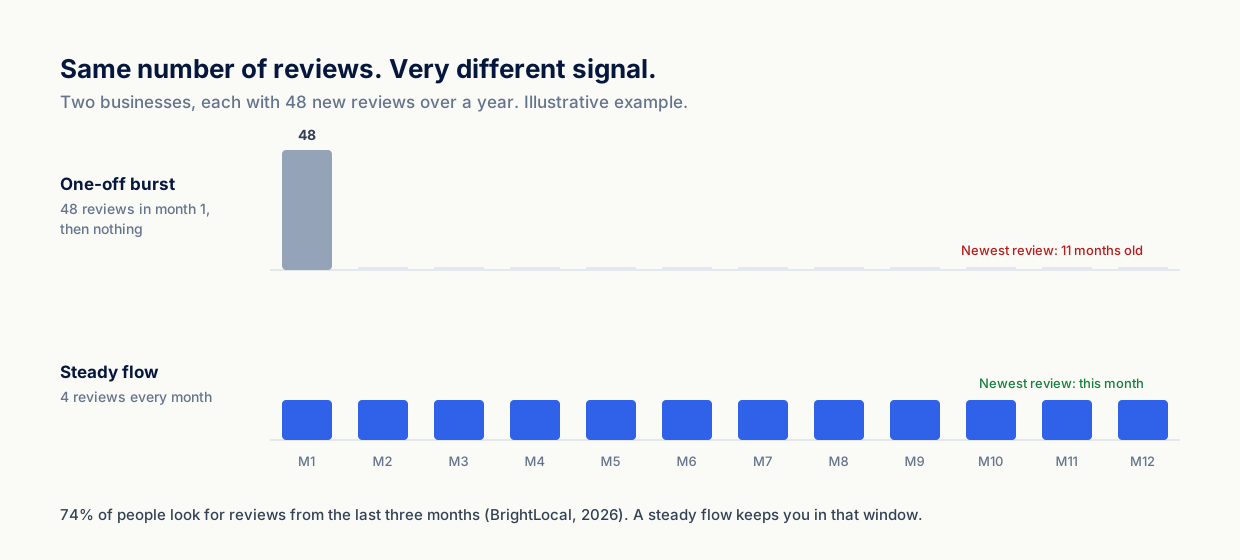
- a steady flow of reviews over time, rather than sudden bursts
That last one matters more than most owners realise. Fifty reviews collected in one week, then nothing for a year, looks less natural, and is less useful to customers, than one or two a week, every week.
Reviews won't make up for a weak profile, though. In the same report, the top-ranked factor overall is choosing the right primary business category on your Google Business Profile. Get the basics right first, then build reviews on top.
Do customers actually read Google reviews before choosing a business?
Most do, and they're getting pickier. BrightLocal's 2026 Local Consumer Review Survey asked 1,002 US adults how they use reviews. The survey is American, but the habits it describes will be familiar to anyone who's chosen a plumber or a dentist from their phone.
| What consumers said | 2026 |
|---|---|
| More likely to use a business after reading positive reviews | 85% |
| Put off by negative reviews | 77% |
| Look for reviews written in the last three months | 74% |
| Look for reviews written in the last two weeks | 32% (up from 20%) |
| "Always" read reviews when looking for a business | 41% (up from 29%) |
| Will only use a business rated 4.5 stars or higher | 31% (up from 17%) |
Two things stand out.
Recency now matters as much as the rating. A 4.8-star profile whose newest review is from last year tells a customer very little about how you work today. Old reviews still count, but recent ones do the persuading.
The bar has gone up. Nearly a third of people now say they'll only consider businesses at 4.5 stars or above. That isn't a reason to worry about every four-star review. It's a reason to ask every customer for a review, so your average reflects the experience of all your customers, not only the few who felt strongly enough to post unprompted.
Do Google reviews affect what ChatGPT and Google's AI recommend?
Increasingly, yes. In the same BrightLocal survey, 45% of consumers said they'd used ChatGPT or another AI tool to get local business recommendations, up from 6% a year earlier. That makes AI the third most popular source. And 82% said they read AI-generated summaries of reviews.
When someone asks Google's AI Mode or ChatGPT for "a good electrician near me", the answer tends to draw on what customers have said about each business. Your Google reviews, along with reviews on other sites, help shape that answer.
There's no special trick to this. Google says there are no extra requirements to appear in its AI results beyond normal good practice, and it lists keeping your Business Profile information current as part of that. The same work that helps you in the map results (a complete profile and regular, genuine reviews) is what helps you in AI answers.
Should I reply to every Google review?
Yes, but mainly for the people reading your reviews, not for your ranking.
Google encourages replying, saying it shows you value customer feedback. But replies don't appear to move rankings much. In Whitespark's 2026 survey, "owner responses to most reviews" sits well down the list of map ranking factors. Its effect on customers is much bigger: 80% of people in BrightLocal's survey said they're more likely to use a business that responds to all of its reviews.
A reply is less a message to the reviewer than a sign to everyone else that someone is paying attention. That matters most with negative reviews, where a calm, specific reply often reassures future customers more than the review itself worries them.
A good reply:
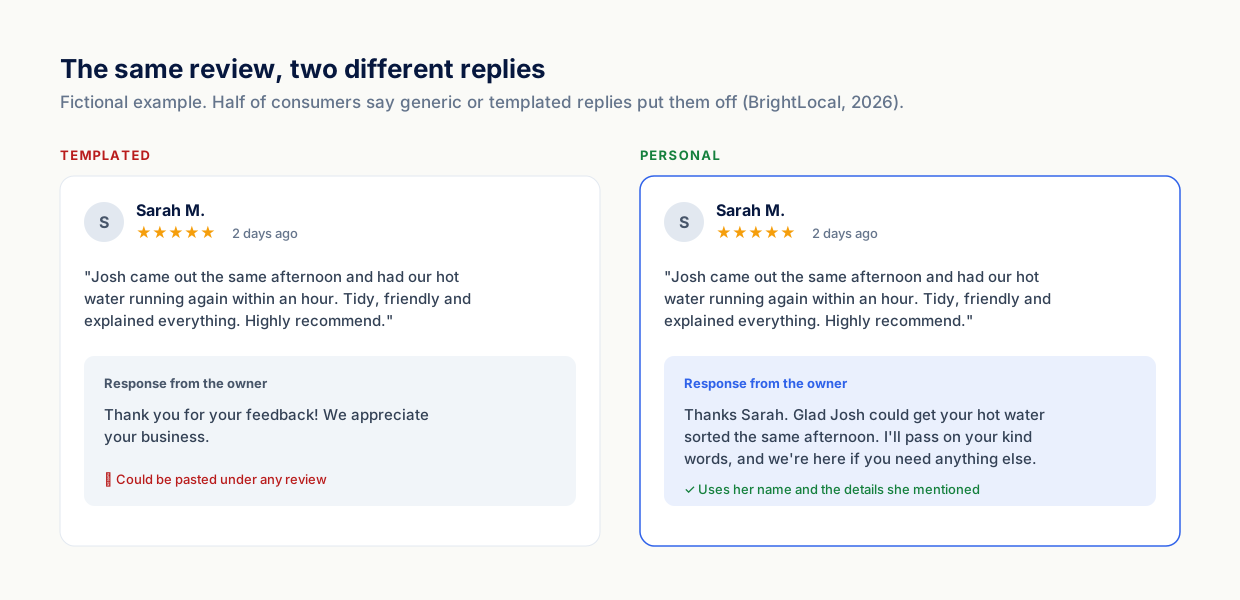
- uses the customer's name and mentions something specific from their review
- thanks them without gushing
- for a negative review, acknowledges the problem, avoids arguing in public, and offers a direct way to resolve it ("give me a call on…")
- goes up within a day or two
Can I use AI to write my review replies?
You can. Google doesn't prohibit it, and it has been testing its own "reply with AI" feature inside Business Profile. The risk isn't Google. It's your customers: half the people in BrightLocal's survey said generic or templated replies put them off.
The approach that works is to let AI produce a first draft, then have a person edit it so it sounds like you and refers to what the customer actually said. Never publish an unedited AI reply to a negative review. Those are the replies prospective customers read most closely.
What am I not allowed to do with Google reviews?
You're allowed, and encouraged, to ask customers for honest reviews. Where businesses get into trouble is trying to control what those reviews say. There are two sets of rules to keep in mind: Google's own policy, and Australian consumer law.
Google's review policy prohibits:
- offering anything in return for a review, such as discounts, free products or payment
- only asking customers you expect to be happy (often called "review gating")
- discouraging customers from leaving negative reviews
- reviews from current or former staff, or anyone else with a conflict of interest
- pressuring customers to leave a review while they're still at your premises
- "unusual volumes or patterns" of reviews
The ACCC warns that businesses risk breaking the law if they:
- write fake reviews, or arrange for someone else to (this one is plainly illegal)
- suppress or edit genuine negative reviews
- offer incentives for reviews unless they're given regardless of whether the review is positive or negative, and clearly disclosed
Google is enforcing this more actively. It blocked or removed more than 292 million policy-violating reviews in 2025. When it sees a sudden spike of suspicious reviews on a profile, it can remove them and temporarily pause new reviews on that profile.
How fast is too fast?
Google doesn't publish a number, so be wary of anyone who quotes you a precise daily limit. What it does say is that "unusual" volumes or patterns are a red flag.
The safe approach is to let reviews arrive at the natural pace of your work. Ask each customer soon after you've finished the job, rather than saving them up. If your profile has been quiet for a long time and you want to reach past customers, spread those requests over several weeks rather than messaging your whole list in one afternoon.
If you send review requests by SMS or email, Australia's Spam Act is also likely to apply. Make sure you have the customer's consent to contact them, and include a simple way to opt out.
Where should I start?
If you do nothing else, do these five things, in this order.
- Claim and complete your Google Business Profile. Choose the most accurate primary category, then add your services, service area, opening hours, a clear description and real photos. If you work from home or at customers' premises, set yourself up as a service-area business so your address stays hidden.
- Get your review link. Your Business Profile gives you a direct link to leave a review. Save it somewhere you can send it quickly, and consider a QR code for your counter, invoices or van.
- Ask every customer, soon after the job. A short, personal message the same day works better than a generic email a month later. Ask everyone, not just the customers you think were happy.
- Reply to every review within a day or two. Thank people for positive reviews by name. Answer negative ones calmly and offer to fix the problem offline.
- Check in once a month. Look at how many new reviews you received, your average rating, and whether anything needs a reply. A steady trickle is the goal, not a spike.
None of this needs special software. What it needs is consistency, which is where most busy owners fall down. Asking for reviews is the first job to slip when the week gets full. If you'd rather hand it off, our Google Reviews Management service sets up the requests, monitors new reviews and drafts replies for you to approve.
Frequently asked questions
How many Google reviews does my business need?
There's no magic number. Search for your main service in your area and look at the businesses in the top three map results. Their review counts, ratings and how recent their reviews are give you a realistic benchmark. Being steadily ahead of them on recent reviews matters more than reaching a round number.
Can I delete a bad Google review?
Not simply because you don't like it. You can report a review that breaks Google's rules, for example if it's fake, from a competitor, or not about a real experience with your business. For a genuine negative review, the best response is a calm, specific public reply. In Australia, suppressing genuine negative reviews can also mislead consumers.
Can I ask customers for a review in person?
Yes. Mentioning it at the end of a job and leaving them your link or QR code is fine. What Google doesn't allow is pressuring people to write the review on the spot, while they're still at your premises.
Can I offer a discount or prize for leaving a review?
Not on Google. Google's policy bans incentives of any kind for reviews, even if you'd accept a negative review. Australian law adds that any incentive used on other platforms must apply regardless of the rating and be clearly disclosed.
Do reviews on other sites matter?
Google reviews matter most for Google's map results, but AI tools draw on reviews from many sites when they recommend businesses. If your industry has a site customers rely on, such as a trade directory or booking platform, it's worth keeping that profile active too.
Sources
- Google Business Profile Help: How to improve your local ranking on Google
- Google Maps: Prohibited and restricted content policy
- Google Search Central: AI features and your website
- BrightLocal: Local Consumer Review Survey 2026
- Whitespark: Local Search Ranking Factors 2026
- ACCC: Online reviews for products and services
- Search Engine Roundtable: Google Maps blocked 292 million reviews in 2025
- Search Engine Land: Google Business Profile tests AI-generated replies to reviews