Executive Summary
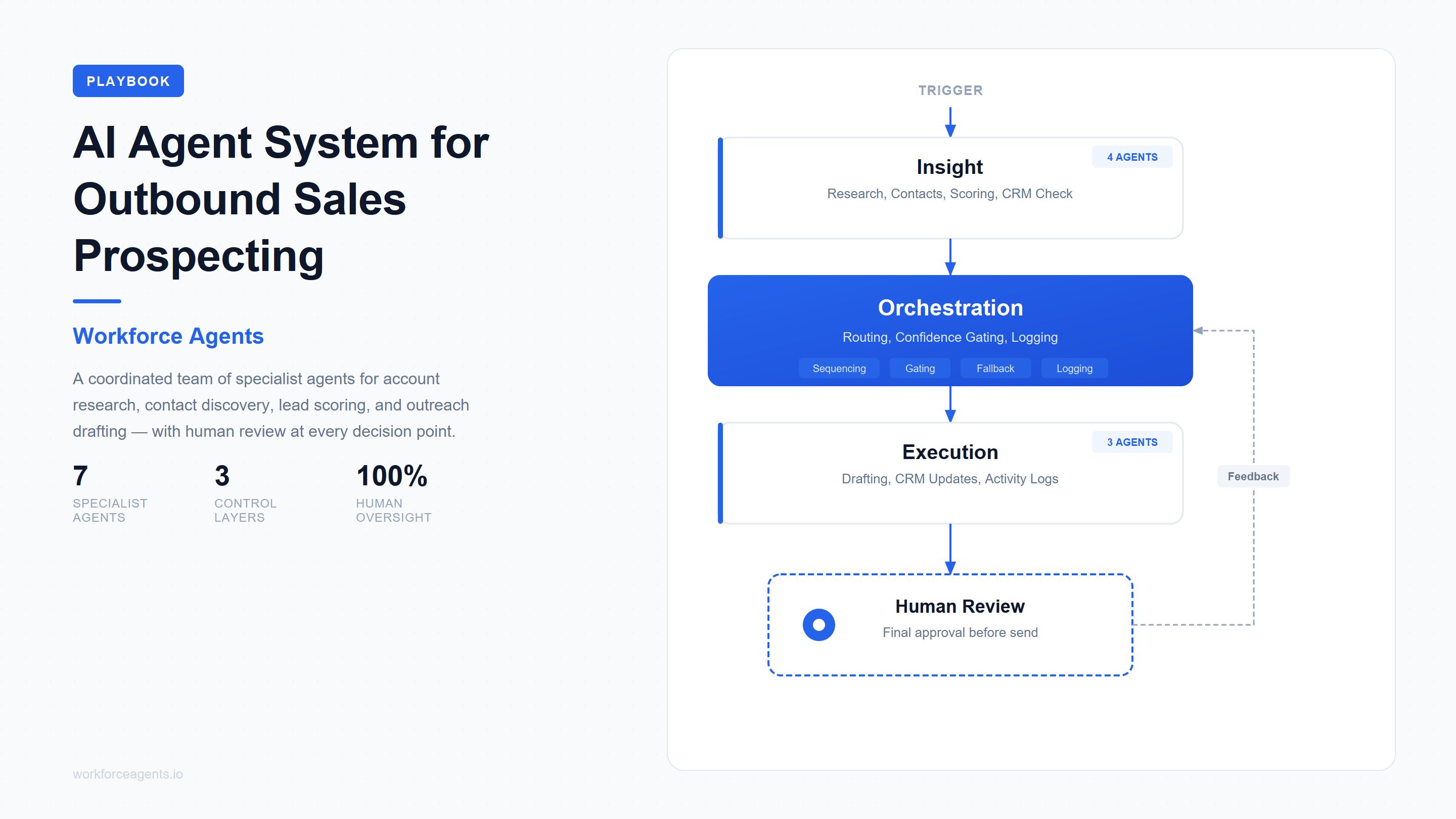
An AI agent system for outbound sales prospecting is a coordinated team of specialist agents that handles account research, contact discovery, lead scoring, and outreach drafting — while keeping humans in control of targeting decisions, messaging approval, and pipeline strategy. In a typical enterprise sales operation, reps spend 65-70% of their time on non-selling activities such as research, data entry, and administrative tasks, according to Salesforce's State of Sales research. A properly architected prospecting system reduces that preparation overhead by 60-80%, enabling each seller to work 3-4x more qualified accounts per week without sacrificing relevance or quality. For a team of five sellers currently handling 100 accounts per week, that translates to recovering roughly 40 hours of selling capacity every seven days — capacity that is currently buried under coordination work.
This playbook is for Heads of Sales, RevOps leaders, and commercial operators who need more pipeline coverage without turning outbound into a volume game.
Key takeaway: Outbound prospecting compounds when insight, execution, and human judgement are separated into a coordinated system instead of forced into one overloaded role.
The Workflow Problem
Outbound prospecting usually breaks long before the first email is sent. The visible problem is low reply rates. The real problem is that the workflow underneath is fragmented, manual, and inconsistent.
In a typical current-state process, a rep starts with a target account list or territory. They search public information to understand the business, scan for recent changes, identify likely buyers, check whether the account already exists in the CRM, decide whether the account is worth pursuing, draft an opening message, and then log activity back into the system. Even in disciplined teams, that sequence takes 20-45 minutes per account before any meaningful outreach happens.
That sounds manageable until volume enters the picture. A team of five sellers each working 20 new accounts per week is asking the organisation to handle 100 account evaluations, hundreds of contacts, dozens of writing decisions, and a significant amount of CRM hygiene every seven days. Research from McKinsey's B2B Sales report indicates that high-performing sales organisations automate at least 30% of sales activities — yet most mid-market teams still operate at near-zero automation in prospecting workflows.
When that work is done manually, three things happen consistently.
First, research quality drops under time pressure. Reps default to surface-level signals, generic pain points, and obvious messaging. A 2024 Gartner study found that 72% of B2B sellers say they feel overwhelmed by the number of tasks required to close a deal — and prospecting preparation is where corners get cut first.
Second, follow-through breaks. Good prospects get identified but never contacted because the administrative load piles up. The Harvard Business Review has documented that the average response time to an inbound lead is 42 hours — and outbound follow-up is typically even slower because it competes with reactive work.
Third, data quality decays. Contact details, notes, and next steps stay in inboxes or spreadsheets instead of the system of record. Salesforce estimates that CRM data decays at approximately 30% per year when maintenance is manual, meaning a third of your pipeline intelligence is stale at any given moment.
The cost of the status quo is larger than most teams estimate. If manual research and admin consume even 25 minutes per account, 100 accounts per week equals more than 40 hours of work — one full-time headcount equivalent — spent preparing to sell rather than selling.
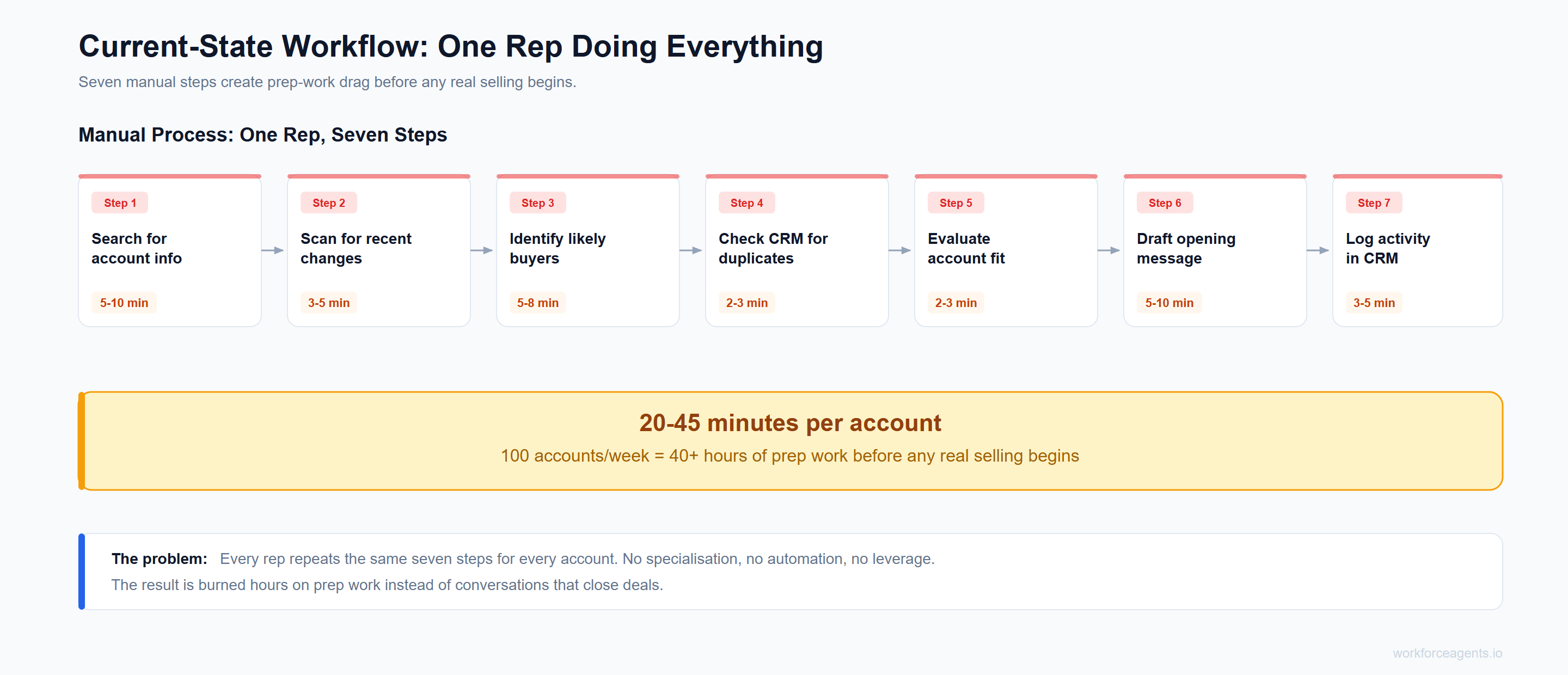
Key takeaway: The biggest outbound prospecting leak is not writing capacity but the manual chain of research, prioritisation, drafting, and CRM upkeep around every account.
Where AI Actually Fits
AI fits best in outbound prospecting when it takes over the repeatable analytical and execution-heavy steps while leaving judgement, relationship-building, and commercial discretion with humans.
What gets automated:
- Account research across public and internal sources
- Signal detection — hiring changes, growth indicators, new initiatives, timing triggers
- Contact discovery and role matching against target buying profiles
- Lead and account scoring against a defined ideal-customer profile
- First-draft outreach based on account context and approved messaging standards
- CRM entry, record updates, and activity logging
- Prioritisation queues for reps and managers
What does NOT get automated:
- Deciding whether a market or segment is strategically worth pursuing
- Approving messaging standards and risk thresholds
- Handling ambiguous accounts with conflicting signals
- Relationship management once a prospect engages
- Commercial judgement on deal strategy, concessions, or timing
- Exceptions involving compliance, reputation, or sensitive buyer context
Where humans remain in the loop:
- Approving target-account criteria and scoring logic
- Reviewing outreach before send — especially in early deployments
- Handling accounts with incomplete or contradictory data
- Choosing whether to contact high-value or politically sensitive accounts
- Refining messaging based on live market feedback
- Deciding when to escalate from automated preparation to human-led pursuit
This distinction matters. Research from Boston Consulting Group found that AI-augmented teams outperform fully automated approaches by 25-40% on complex B2B tasks. The reason is straightforward: the right goal is not to remove the seller but to remove the low-leverage work that prevents the seller from spending time where judgement actually matters.
Key takeaway: In production, AI should automate preparation and coordination around outbound prospecting, not replace human commercial judgement.
Agent Architecture
A workable outbound prospecting system is built as three coordinated layers: Analyst Agents, Assistant Agents, and an Orchestration Layer.
a. Analyst Agents (Insight Layer)
Analyst Agents handle the interpretation work. They detect what is changing, what matters, and what should be prioritised.
- Account Research Agent — analyses company information, recent news, financial signals, technology footprint, and likely commercial relevance. Consumes public web data, searches, and reads full page content to build a detailed company snapshot.
- Contact Intelligence Agent — maps the likely buying group: who owns the problem, who influences the decision, who controls budget. Searches professional databases, scores contacts against role fit, seniority, and accessibility.
- Scoring Agent — ranks opportunities using weighted dimensions: problem ownership (25%), initiative proximity (20%), function relevance (15%), buying power (15%), champion potential (10%), seniority (10%), and novelty (5%). Produces a composite score with reasoning.
- CRM Status Agent — checks whether the account or contacts already exist in the CRM, whether prior outreach has occurred, and whether duplicate work should be blocked. Returns a confidence-rated status.
b. Assistant Agents (Execution Layer)
Assistant Agents act on the findings from the insight layer.
- Outreach Drafting Agent — produces first-touch messages based on approved messaging rules, the strongest account-specific signal, and the contact's likely buying role. Enforces word limits, forbidden phrases, and tone standards.
- CRM Writer Agent — creates or updates account and contact records with proper associations. Validates email addresses before writing. Handles conflict detection (duplicate records).
- Activity Logging Agent — records what happened, when, and why. Creates an audit trail across the entire workflow.
c. Orchestration Layer
The Orchestration Layer is what makes this a system rather than a collection of disconnected automations.
- Routes work in sequence: CRM check, research, contact mapping, scoring, drafting, record update
- Stops execution if data confidence is too low (uncertain CRM matches block downstream writes)
- Prevents duplicate outreach if the account already exists or is actively being worked
- Sends ambiguous cases to human review rather than forcing a decision
- Maintains logs for auditability and debugging
- Retries deterministic tasks but escalates judgement tasks to a human
Architecture Flow
A trigger enters from a target account list, inbound signal, or seller request. The Orchestration Layer first sends the account to the CRM Status Agent. If the account is net-new or safe to progress, the workflow passes to the Account Research Agent and Contact Intelligence Agent in parallel. Their outputs feed the Scoring Agent, which ranks opportunity quality and urgency. If thresholds are met, the Outreach Drafting Agent creates a message draft and the CRM Writer Agent prepares record updates. The final package — account summary, contact recommendations, score rationale, and draft message — is routed to a human seller for review. All actions are logged centrally.
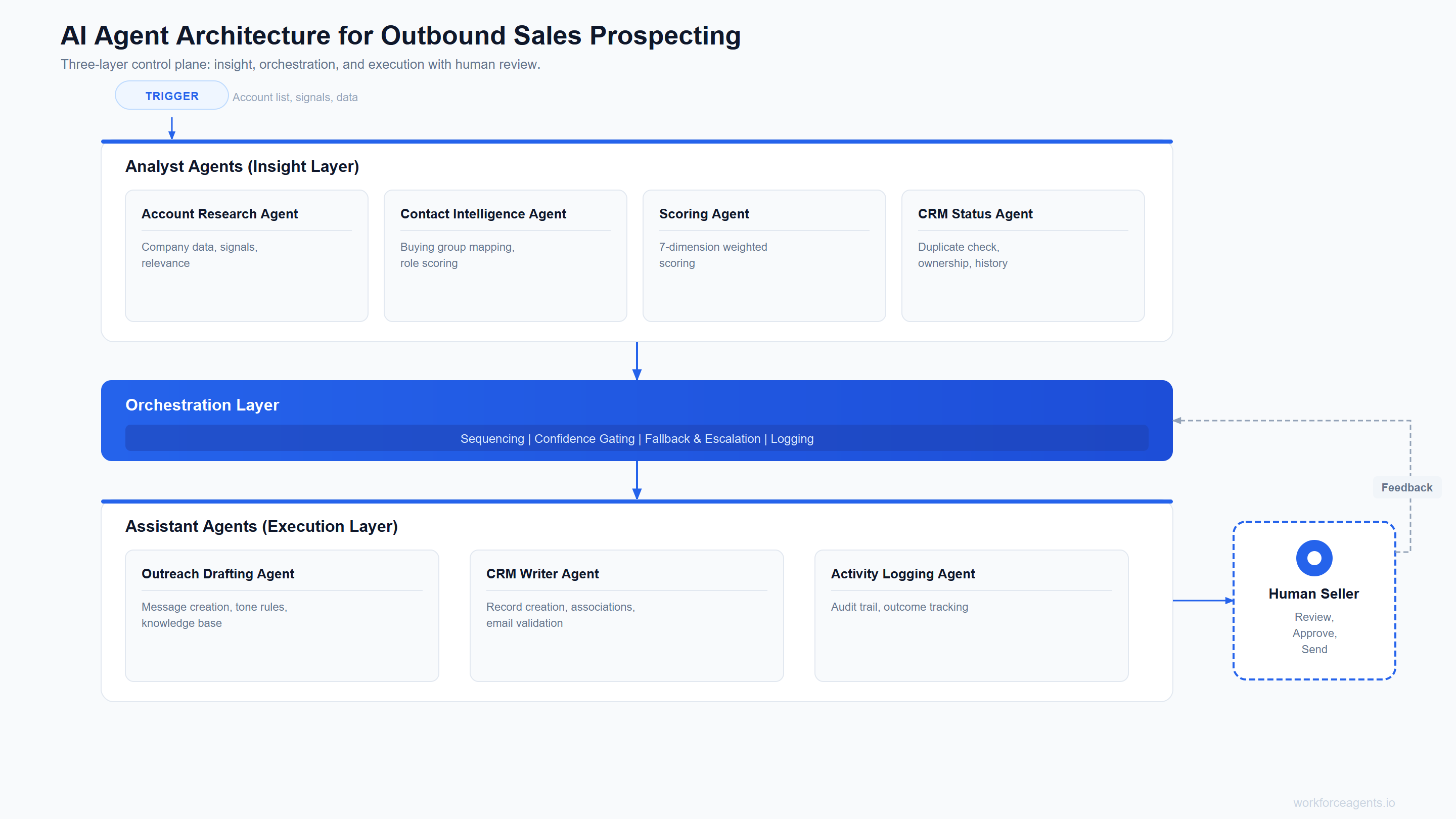
Key takeaway: Outbound prospecting becomes dependable when specialist agents handle narrow tasks and an orchestration layer controls sequence, confidence gating, and escalation.
End-to-End Workflow
- A target account enters the system through a list upload, seller request, buying signal, or scheduled territory review.
- The Orchestration Layer sends the account to the CRM Status Agent to determine whether the account exists, whether prior outreach occurred, and whether duplicate work should be blocked.
- If the account is eligible, the Account Research Agent gathers business context, current signals, and commercial relevance — reading full web pages where necessary, not just search snippets.
- In parallel, the Contact Intelligence Agent identifies likely stakeholders, maps the buying group, and scores contacts against role fit and accessibility.
- The Scoring Agent evaluates account quality using fit, timing, signal strength, and buying relevance. Contacts are ranked with transparent scoring breakdowns.
- If the score is below threshold, the system logs the account and parks it for later review. No forced outreach on low-quality targets.
- If the score is above threshold, the Outreach Drafting Agent prepares a first-touch message using approved positioning and the strongest account-specific signal. Messages are capped at 120 words and adapt to the contact's buying role.
- The CRM Writer Agent creates or updates account and contact records, attaches relevant notes, and records the recommended next action. Contacts without verified email addresses are skipped entirely.
- A human seller reviews the complete package: account summary, contact recommendation, score rationale, and message draft.
- The seller edits where needed, approves outreach, or rejects the recommendation with feedback that improves future scoring and messaging.
- The Orchestration Layer logs outcomes across the full workflow for auditability and continuous improvement.
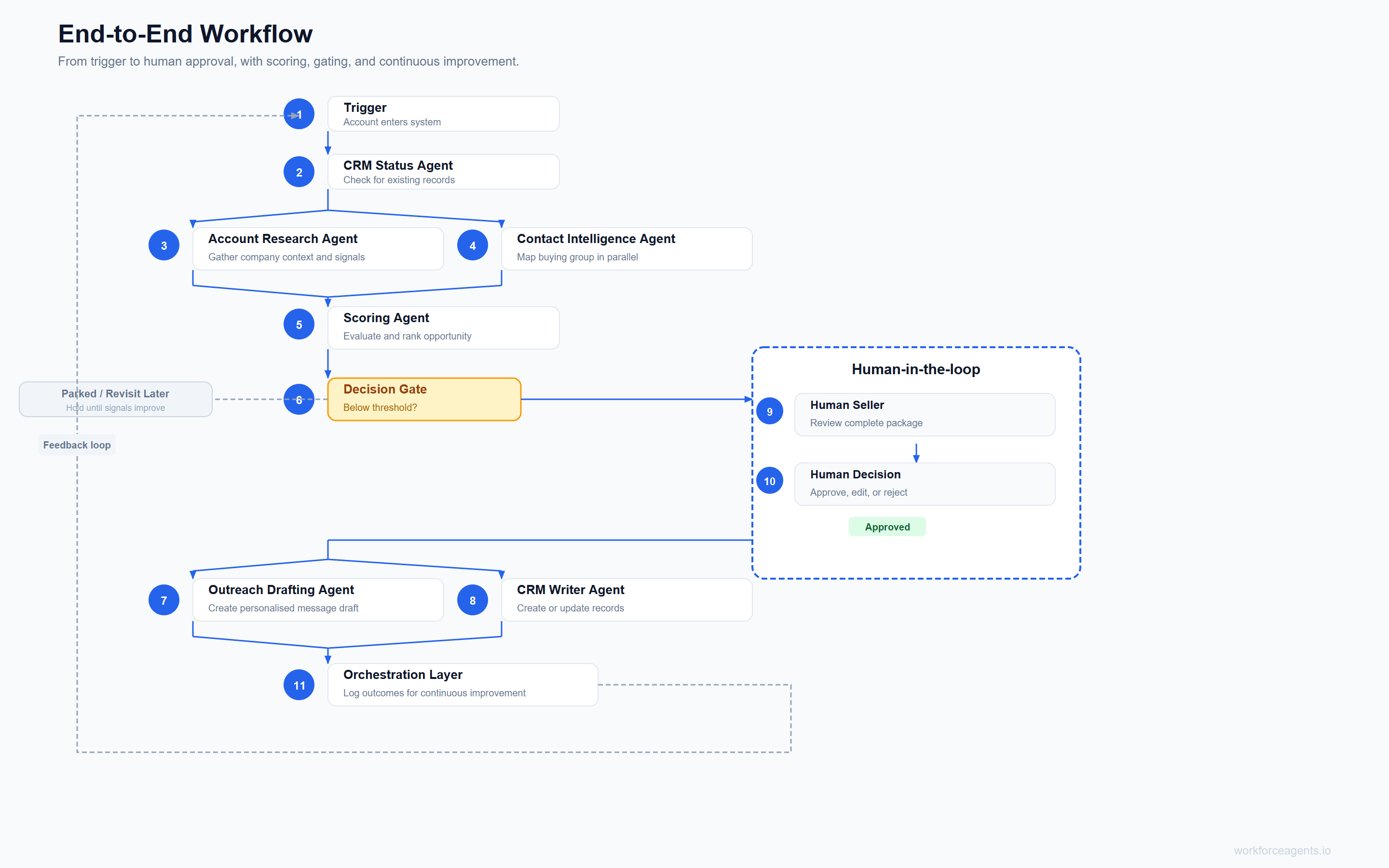
In mature deployments, steps 7-8 may run automatically for standard accounts while strategic or high-value accounts remain fully human-approved.
Key takeaway: The workflow is not 'AI sends messages' — it is 'AI prepares a high-quality selling package that a human can approve, use, and improve fast.'
Data Requirements
This system depends on access to both external signals and internal commercial records.
Systems involved:
- CRM (account, contact, and activity data)
- Email or sequencing environment (for draft creation)
- Professional contact databases (for discovery and enrichment)
- Web search and page reading capabilities (for account research)
- Optional: call notes, meeting notes, or sales intelligence records
Data quality dependencies:
- Consistent account naming and ownership in the CRM
- Clean duplicate handling rules (company-level and contact-level)
- Accurate contact-role fields where available
- Usable historical activity data (even minimal is workable)